
Vertical Lift PCS
Keywords:
Vertical Lift PCS
Category:
Vertical lift parking systems, also known as parking tower garages, use elevators to vertically lift and lower vehicles. Horizontal transfer carriages at each parking space handle the lateral movement of vehicles, working in coordination to facilitate vehicle storage and retrieval. Each parking level accommodates two vehicles with vertical movement, occupying a minimal footprint of just 50 m²—less than 1 m² per vehicle on average—and offering an average retrieval time of 75 seconds. Among all automated parking systems, this is one of the most space‑efficient and fastest‑operating parking solutions.
The main types of vertical lifting equipment include comb‑tooth type, vehicle‑platform type, and car‑box tower type.
Technical Specifications:
| Device Model | Vertical Lift PCS |
| Vehicle Dimensions (MM) | 5300*1900*1550/2050 |
| Vehicle Weight (KG) | ≤2350 |
| Single-unit footprint | 50-130m2 |
Operation Method: License plate recognition, facial recognition, touch screen sensing areas, and the control box all feature Chinese LCD displays.
Equipment Advantages:
■ The tallest tower currently under construction and in operation has 39 floors, covers an area of 129 m², and provides a total of 156 parking spaces.
■ Uses a direct-in, direct-out approach for fast vehicle access and retrieval, eliminating the need to turn around or reverse.
■ It occupies a small footprint, saving valuable land space while also serving as a landmark building for the city.
■ Vertical lift equipment typically allows two or more vehicles to be parked on each parking level.
■ Vehicle storage and retrieval are accomplished through the coordinated operation of the elevator’s lifting mechanism and the lateral movement mechanism on the elevator.
Applicable Environment: Primarily suitable for urban and commercial center areas—regions with relatively limited space and minimal height restrictions—the product comes in various forms, including above ground, underground, semi‑above ground, and semi‑underground.
 01 Comb-tooth Taku Equipment
Comb-tooth tower library composition:
Main framework: Available in two forms—steel structure and civil engineering.
Lifting mechanisms are available in two drive configurations: wire rope and chain. For buildings with 25 floors or fewer, a chain drive is recommended; for buildings with more than 25 floors, a wire rope drive is recommended.
Lifting Mechanism: The comb‑tooth lift drives the parking space to move up and down, completing the vehicle storage and retrieval process through engagement with the parking space’s comb teeth.
Parking Mechanism: The comb‑tooth parking rack is used to park vehicles and can work with the comb‑tooth lift to complete the vehicle storage and retrieval process.
Rotating mechanism: Used for vehicle U-turns, enabling vehicles to enter the parking space in reverse and exit in forward gear.
Import and export equipment: Equipped with automatic garage doors that are interlocked with equipment operation, providing excellent safety and management performance.
Working principle of the comb-tooth parking tower: The lifting mechanism raises the vehicle to the upper part of the designated parking level. The lateral moving mechanism on that parking level then shifts the parking rack horizontally into the shaft, after which the lift descends. Once the vehicle is securely parked on the parking rack via a comb‑tooth exchange, the lift lowers the vehicle to the ground level, where it waits for the next command. Simultaneously, the lateral moving mechanism parks the vehicle in a designated parking space, completing the entire parking operation.
Using the lifting mechanism, the vehicle is raised to the upper part of the designated parking level. The lateral transfer mechanism on that parking level then shifts the parking rack horizontally into the shaft, after which the lift descends. Once the vehicle is parked onto the parking rack via a comb-tooth exchange, the lift lowers back to the ground floor to await the next command, while the lateral transfer mechanism parks the vehicle in a designated parking space, completing the parking operation.
 02 Vehicle‑Carrying Deck Tower Storage Equipment
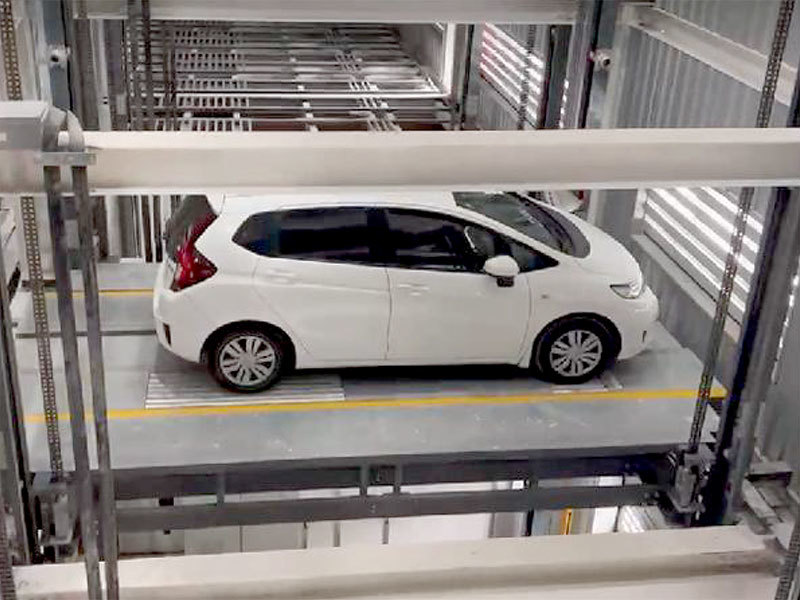
The operating principle of vertical lift parking equipment is as follows: After the lifting mechanism raises the vehicle to the parking level, it is precisely positioned and locked in place to ensure safety and prevent falling. Then, the lateral moving mechanism on the lifting unit shifts the vehicle and the vehicle carrier horizontally to the designated parking space. Once the positioning pins are unlocked, the system moves to an empty parking space, retrieves the vehicle carrier, lowers it to the ground floor, and waits for the next command.
Advantages of Car‑Loading Platform Parking Systems: This type of parking equipment features fast operating speeds, high stability, and interlocked operation with the equipment’s movement, resulting in superior safety performance.
After the vehicle is lifted to the parking level by the lifting mechanism and securely locked into place, the system ensures safety by preventing accidental falls. Then, the lateral movement mechanism on the lifting mechanism is used to horizontally shift the vehicle and its carrier plate to the designated parking space. Once the locking pins are released and the vehicle is properly positioned, it moves to an empty parking space to retrieve the carrier plate.
Descend to the ground floor and wait for the next instruction.
 03 Car Cabin Tower Equipment
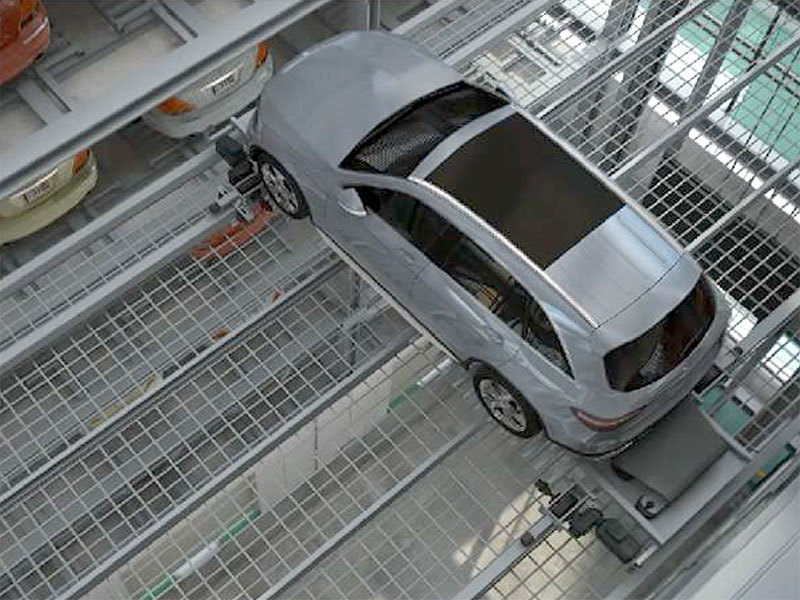
The elevator‑type parking equipment combines the features of vertical lift and horizontal move systems, enabling simultaneous operation in both the vertical and horizontal directions, thereby significantly enhancing vehicle storage and retrieval efficiency. The main structure of this equipment consists of parking spaces, aisles, and entrances/exits; the aisles serve as the operational channels for the elevators, which are equipped with lifting platforms, lateral transfer carts, carriers, and level‑positioning devices. Parking spaces are arranged in parallel along both sides of the aisles, with each floor accommodating 4 to 12 parking spaces depending on site conditions; the ground floor may feature one or more entrances/exits. Carriers are responsible for transporting vehicles between the entrances/exits and the lifting platforms, as well as between the lifting platforms and the parking spaces. Subsequently, the elevators and lateral transfer carts operate in synchrony to deliver vehicles to their designated locations.
Advantages of Car Elevator Parking Systems: This type of parking equipment boasts high space utilization and a high degree of智能化 (smart technology), making it ideal for installation in hospitals, hotels, shopping malls, and other similar venues.
The elevator‑type parking equipment combines the features of vertical lift and horizontal move‑type systems, enabling simultaneous operation in both the vertical and horizontal directions, thereby significantly improving vehicle storage and retrieval efficiency. The main structure of this equipment consists of parking spaces, aisles, and entrances/exits.
The passage serves as a running channel for the elevator, which is equipped with a lifting platform, a lateral transfer cart, a transporter, and a level‑landing positioning device.
Related Cases

success cases
success cases
success cases
Inquire Now
If you have any suggestions for our products or services, please leave us a message!


TOPP
Hotline: 400-816-8015
E-mail: marketing@top-parking.com
Address: 162 Gongyuan Road, Fengrun District, Tangshan City, Hebei Province, China

TOPP | Powered by www.300.cn | SEO | Business License | Privacy Policy